
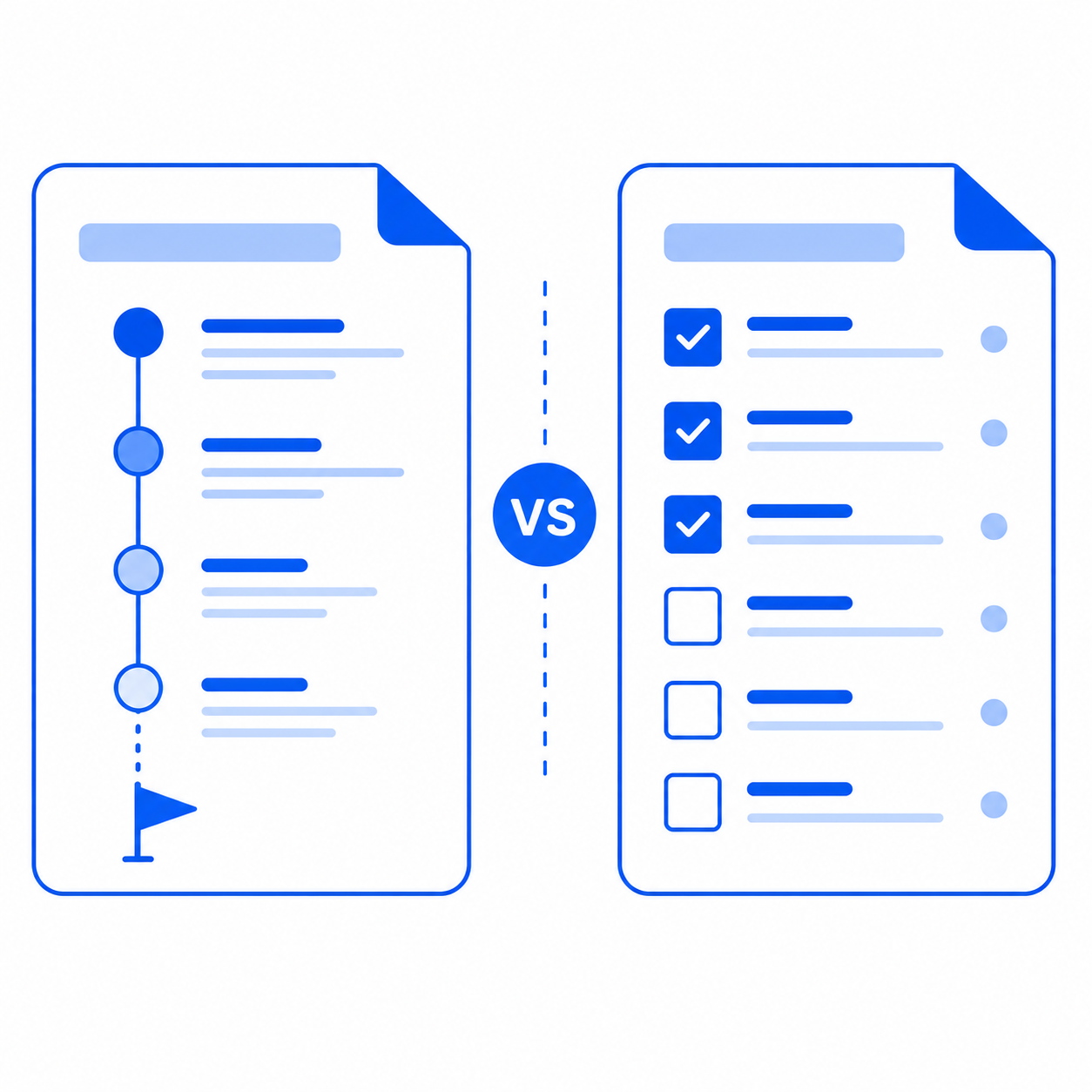
Product Roadmap vs Project Plan: What’s the Difference?
Product roadmap vs project plan is a distinction that gets flattened in a lot of organizations — and that flattening causes real problems. Misaligned expectations, wrong audiences getting the wrong documents, and teams that treat a strategic direction as a fixed delivery commitment.
The distinction matters in practice: a product roadmap and a project plan are fundamentally different artifacts, built for different purposes, managed by different roles, and interpreted in very different ways by the people who read them.
A single line on a roadmap slide — “Q3: rebuild checkout” — can quietly get read by a VP as a delivery date, full stop, with no sense that “Q3” was a directional bet rather than a commitment backed by a project plan. That gap between what a roadmap communicates and what a stakeholder hears is the single most common cause of the confusion this guide exists to prevent. This guide explains the difference clearly, when to use each, and how they work together in a healthy product organization.
The Short Version
A product roadmap communicates direction and priorities — what the product is working toward and why, over a medium-to-long time horizon. It’s a strategic communication tool.
A project plan communicates execution — who is doing what, by when, and how. It’s an operational delivery tool.
A roadmap answers: Where are we going? A project plan answers: How exactly are we getting there, and when?
Both are necessary. Neither replaces the other. Teams that get into trouble aren’t usually the ones lacking one of these documents — they’re the ones using a single document and asking it to do both jobs at once.
What Is a Product Roadmap?
A product roadmap is a high-level visual plan that communicates the direction of a product over time. It shows:
- What themes or goals the team is working toward
- Which features or initiatives are planned and in what rough sequence
- How the product strategy connects to business objectives
Roadmaps are strategic artifacts, not delivery commitments. The best roadmaps are outcome-oriented — they describe the problems being solved and the goals being pursued, rather than a precise list of features with exact delivery dates. ProductPlan’s research on outcome-driven roadmapping makes the case directly: a roadmap full of features in isolation doesn’t communicate why any of them matter, while an outcome framing keeps the team focused on results rather than shipped volume.
They are also living documents. A roadmap is expected to change as the team learns more, as priorities shift, and as the market evolves. Treating a roadmap as a fixed commitment is one of the most common and damaging mistakes in product management — and the mistake rarely originates with the PM. It comes from a stakeholder who was never told the roadmap wasn’t a delivery calendar. Atlassian’s agile roadmap guidance frames this directly: a roadmap should stay dynamic and responsive to shifts in the competitive landscape, which is a different job entirely from a fixed delivery schedule.
Who owns it: The product manager.
Primary audience: Leadership, stakeholders, cross-functional partners, and the full product team.
Time horizon: Usually 3–12 months, with decreasing specificity further out (Now / Next / Later format, or quarterly themes).
Format: Often a timeline, a kanban-style board, or a strategic narrative — prioritizing clarity of direction over granular detail.
What Is a Project Plan?
A project plan is a detailed operational document that describes how a specific initiative will be executed. It typically includes:
- A full task breakdown with owners and dependencies
- Milestone dates and deadlines
- Resource allocation
- Risk and mitigation plans
- Completion criteria
Project plans are designed for execution coordination, not strategic communication. Their value comes from precision — specific tasks, specific owners, specific dates. They’re updated frequently as work progresses.
Who owns it: Traditionally, a project manager. In many agile product teams, this work is distributed — sprint planning and the backlog replace a formal project plan for day-to-day execution.
Primary audience: The team doing the work — engineers, designers, QA, operations.
Time horizon: A specific project from start to finish — days to months.
Format: Gantt chart, task board (kanban), sprint board, or a structured project management tool like Asana, Monday.com, or Jira.
Product Roadmap vs Project Plan: Key Differences
| Dimension | Product Roadmap | Project Plan |
|---|---|---|
| Purpose | Communicate strategic direction | Coordinate execution |
| Owner | Product Manager | Project Manager / PM / Tech Lead |
| Audience | Stakeholders, leadership, full team | The execution team |
| Time horizon | 3–12+ months | Specific project timeline |
| Level of detail | High-level themes and goals | Tasks, owners, dates |
| Flexibility | Expected to change | Changes are tracked as risks |
| Commitment level | Direction, not deadline | Delivery commitments |
| Primary question | What are we building and why? | Who is building what, and when? |
Where Confusing a Roadmap and a Project Plan Breaks Things
When a product roadmap is treated as a project plan, several specific things go wrong — and they follow a predictable pattern.
Engineering gets locked into premature commitments. If a roadmap entry is treated as a contract — “you said Feature X would ship in Q2” — engineers have no room to learn and adapt. Product work almost always takes longer and evolves more than the initial plan suggests. Treating roadmap entries as deadlines creates the wrong incentives: an engineering team under that kind of pressure will sometimes ship a worse version of a feature specifically to hit a date nobody had actually promised. The fix that tends to work is blunt — labeling every roadmap item with an explicit confidence tag (Committed / Planned / Exploring) so a quarter stops reading as a deadline by default.
Strategy gets lost in execution detail. A roadmap crowded with tasks, subtasks, and owner names has stopped communicating strategy and started functioning as a project tracker — but a bad one, because it lacks the detail that makes a project tracker useful. More than about a dozen items visible in the current quarter is usually a sign that project-plan-level granularity has crept in.
Stakeholders get the wrong information. A roadmap is a communication tool for people who need to understand direction and make decisions. Giving stakeholders a Gantt chart of engineering tasks doesn’t help them make business decisions. It creates false precision and invites micromanagement — the more granular the document, the more a stakeholder feels entitled to ask about individual line items instead of the direction as a whole.
Confusion runs the other direction too. When a project plan is treated as a roadmap, teams lose strategic alignment. Execution detail without clear strategic context leads to the activity trap — teams ship features without understanding why they matter. This direction is harder to spot than the first, because the team looks busy and productive right up until someone asks why a shipped feature didn’t move the metric it was supposed to.
A Worked Example: One Feature, Two Documents
Take a mid-market B2B SaaS company, 40 people, shipping a new bulk-export feature for enterprise customers who are threatening to churn over it. Here’s how the same piece of work shows up in each document, and why keeping them separate actually matters.
On the roadmap, this shows up as a single line under this quarter’s theme: “Reduce enterprise churn risk — bulk export and reporting.” No task list, no named engineers, no exact ship date — just enough for the VP of Sales to tell an at-risk account “this is a top priority this quarter” without promising an exact date the team hasn’t earned yet.
On the project plan, that same line becomes: a data model change (owned by a backend engineer, five days), a CSV and Excel export UI (owned by a frontend engineer, four days, blocked on the data model change), a rate-limiting decision for large exports (owned by the tech lead, needs a design review), and a support-team runbook for customers who hit export limits. Every one of those has an owner and a date, and if the data model change slips, the plan shows exactly what else slips with it.
The failure mode to watch for is putting that task breakdown directly into the roadmap slide because it’s “more informative.” It backfires reliably: a stakeholder quotes the specific four-day frontend estimate to a customer as a delivery date, and when a design review adds a week to the actual timeline, that reads as a broken promise instead of the normal variance a project plan is built to absorb.
How Product Managers and Project Managers Work Together
The product manager and project manager roles are distinct but complementary. Understanding where one ends and the other begins prevents the most common collaboration friction.
The product manager defines what should be built and in what priority order. They maintain the roadmap, own the backlog, and communicate strategy to stakeholders and leadership.
The project manager (or, in many agile teams, a senior engineer or Scrum Master) coordinates how the work gets done. They own the execution plan, track progress against milestones, manage dependencies, and escalate risks — the difference between “what and why” ownership and “how and when” ownership, which is a useful shorthand when a new hire asks who owns what.
In practice at many product teams — especially smaller ones — the PM wears both hats for smaller initiatives, while a dedicated project manager or program manager handles larger, cross-team programs. The best project management tools for product managers often support both modes in the same tool, which is convenient but also exactly how the two documents start blurring together if nobody’s paying attention to which view is which.
When to Use a Roadmap vs. a Project Plan
Use a roadmap when:
- Communicating with stakeholders, leadership, or cross-functional partners about product priorities
- Aligning the team on what matters over the next quarter or year
- Making the case for why certain initiatives are being prioritized over others
- Onboarding new team members or partners who need to understand product direction
Use a project plan when:
- Coordinating execution on a specific initiative with multiple workstreams
- Tracking progress toward a specific delivery milestone
- Managing dependencies between teams (engineering, design, QA, legal, ops)
- Running a product launch that requires precise cross-functional coordination
The Relationship Between Roadmaps, Backlogs, and Project Plans
There’s a third artifact worth clarifying: the product backlog. The backlog sits between the roadmap and the project plan.
The roadmap describes what themes and goals the product is working toward at a strategic level.
The backlog is the ordered list of work items — features, user stories, bugs, tech debt — that the team is considering or planning to build. It’s more granular than a roadmap but less prescriptive than a project plan. The full breakdown of roadmap vs backlog goes deeper on where that line sits and how the two should connect without duplicating each other.
The project plan (or sprint board) is the execution view for a specific time period.
These three artifacts form a hierarchy: vision → roadmap → backlog → sprint plan. For guidance on managing the backlog layer effectively, see the guide on how to prioritize a product backlog.
What a Healthy Roadmap Looks Like
A healthy roadmap in 2026 looks like this:
Outcome-oriented. Instead of “Build new dashboard,” the entry reads “Help power users access their most important metrics in under 30 seconds.” The outcome is the goal; the feature is the hypothesis.
Appropriately uncertain. Items that are far in the future are vague by design. A now/next/later format makes the confidence level explicit — what’s committed, what’s planned, and what’s directional.
Connected to strategy. Each roadmap theme connects to a strategic goal or OKR. Stakeholders can see not just what’s being built but why it’s being prioritized.
Updated regularly. The roadmap is reviewed and updated at least quarterly, with changes communicated proactively to stakeholders. The best roadmap software for startups roundup compares a few tools built specifically around the now/next/later format, for teams choosing a tool to help enforce this discipline.
References
- Atlassian — “Agile Roadmaps: Build, Share, Use, and Evolve”
- ProductPlan — “Outcome-Driven Roadmapping: The Secret to a Focused Product Strategy”
- Cagan, Marty. Inspired: How to Create Tech Products Customers Love. Wiley, 2018.
The quickest way to check whether a team’s roadmap has quietly turned into a project plan: pull it up and count the items that have a named owner and an exact date attached. If that’s most of them, it’s not a roadmap anymore — it’s an undisclosed project plan, and the next stakeholder who reads a specific date off it as a promise will treat it as one.