
How to Localize a Product for International Markets: A PM’s Guide
Why Product Localization Is a Product Decision, Not a Translation Job
Somewhere between 18% and 25% of most SaaS products’ organic traffic already comes from non-English-speaking visitors, and a meaningful share of them hit a signup form, get confused or lose trust, and leave. That’s not lost opportunity in some future market. It’s revenue the product is already generating demand for and actively failing to capture, and the reason is almost never that the market doesn’t want the product — it’s that nobody translated the checkout flow, the error messages, or the onboarding emails.
Seventy-two percent of apps ship English-only, and the ones that don’t see meaningfully different outcomes: localized apps get roughly 128% more downloads per country than English-only versions, and revenue can move within the first week of a localized release. Product localization isn’t a marketing checkbox layered on top of a finished product. It’s a product decision with the same shape as pricing or onboarding — get it wrong and you don’t lose a few points of conversion, you lose the entire market before the sales team even gets a call scheduled.
The reason most product teams under-invest here isn’t disagreement about the opportunity. It’s that localization gets treated as a translation vendor problem instead of a product requirement, which means it enters the roadmap last, gets scoped shallow, and ships as string translation with none of the underlying product decisions — currency, date formats, legal disclosures, cultural tone — actually addressed.
What Product Localization Actually Requires Beyond Translation
Translation converts words. Localization adapts the product to how a market actually thinks, transacts, and expects software to behave, and the two are frequently confused in early planning conversations in ways that under-scope the work.
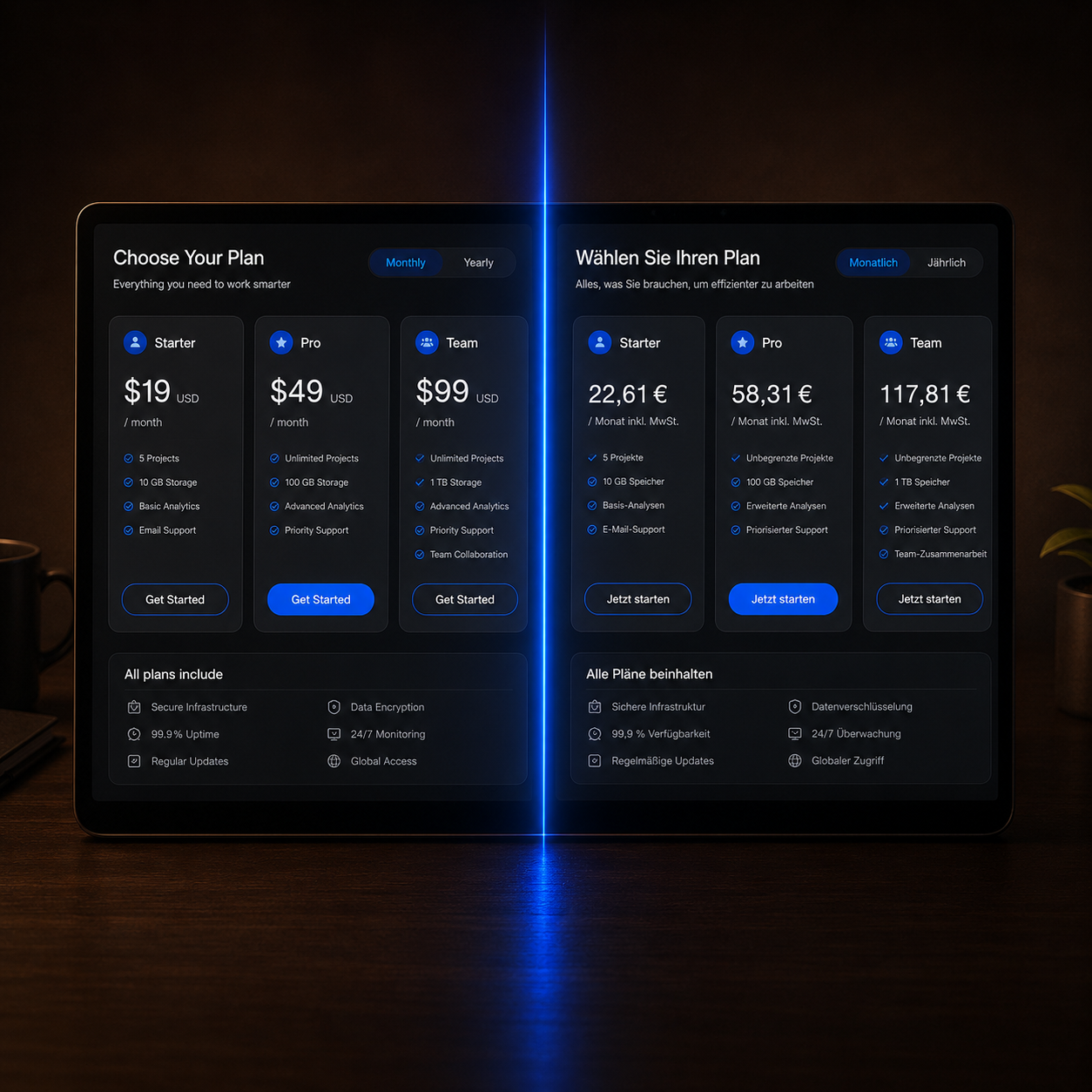
The technical foundation is internationalization, usually shortened to i18n: building the codebase so it can support multiple locales without a rewrite every time you add a language. That means externalizing every user-facing string instead of hardcoding it, supporting right-to-left text rendering if Arabic or Hebrew is anywhere on your roadmap, handling date, time, number, and currency formats per locale rather than assuming US conventions, and giving translated strings room to expand — German and Finnish routinely run 30 to 40% longer than English, and a button built for six-character English labels will visibly break the moment it renders “Einstellungen” instead of “Settings.”
Cultural adaptation is the layer most teams skip because it’s harder to spec. Colors, imagery, and interaction patterns carry different meanings by market — white signals purity in most Western markets and mourning in several East Asian ones, and a celebratory red confirmation banner that reads as “success” to a US user can land very differently in a market where red carries a warning connotation. None of this is exotic edge-case work; it’s the difference between a product that feels translated and one that feels built for the market it’s in.
Legal and regulatory requirements round out the list, and they vary more than most product teams expect: data residency and consent language required under GDPR-style regimes, mandatory price display formats (VAT-inclusive pricing in the EU versus tax-exclusive in the US), and locally required disclosures for regulated categories like finance or healthcare. Skipping this layer doesn’t just hurt conversion — it can block launch entirely once legal review catches it.
Building the Localization Roadmap: Market Selection to Launch
Not every market deserves the same investment, and picking languages by gut feel or by whichever executive just came back from a conference is the single most common way localization budgets get wasted.
Start with data you already have: which non-English locales are generating organic traffic, trial signups, or support tickets in a language other than your source language, using browser-language and IP-geolocation data you’re almost certainly already collecting. Layer in market size, competitive presence, and — critically — a signal on willingness to pay, since a market with high traffic but low purchasing power for your category will localize cleanly and still underperform on revenue. This is the same rigor that belongs in a proper go-to-market strategy: identify a real, findable segment before committing budget, rather than presenting a “large addressable market” slide with no evidence anyone in it is ready to buy.
Once you’ve picked a market, sequence the work in tiers rather than launching everything simultaneously. Tier one is the product itself — UI strings, onboarding, core transactional emails, and error states, because these are what determine whether a user can complete their first task at all. Tier two is support and help content, which reduces ticket volume and cost once users are active. Tier three is marketing and top-of-funnel content, which drives new acquisition but doesn’t help a user who’s already signed up and stuck. Teams that reverse this order — translating the marketing site first because it’s visible and easy to approve — often end up driving localized traffic into an English-only product experience, which converts worse than not localizing at all because it sets an expectation the product doesn’t meet.
Continuous localization, where new strings ship translated alongside the feature rather than in a quarterly batch, matters more as the product matures. A one-time localization project decays the moment the product ships its next feature in English only, and by the time anyone notices, you’re maintaining two products with two different levels of completeness under one price tag.
A Worked Example: Localizing a B2B SaaS Tool for the German Market
A project management SaaS company with roughly $8M in ARR, mostly US-based, saw German-language organic traffic growing steadily with almost no corresponding trial signups. The team’s working theory going in was that German buyers were simply more price-sensitive, so they discounted trial pricing for German IP addresses — and signups moved by less than two percentage points.
User interviews with German trial abandoners surfaced the real blocker fast: it wasn’t price, it was trust and clarity. The checkout page displayed prices without VAT included, which read as an incomplete or possibly misleading price to buyers used to VAT-inclusive display by law and convention. The onboarding emails were in English, which several interviewees read as a signal the product wasn’t seriously supporting the German market rather than as a minor inconvenience. And the terms of service had no German-language version, which for B2B buyers doing any kind of procurement review was an immediate blocker, not a nice-to-have.
The actual fix cost far less than the discounting experiment had: VAT-inclusive pricing display for EU IP addresses, German-translated onboarding emails and in-app strings for the core workflow, and a certified German translation of the terms of service and data processing agreement, since enterprise and B2B buyers routinely require exactly this kind of documentation before procurement will approve a purchase. Trial-to-paid conversion from German traffic moved from roughly 4% to just under 11% over the following two quarters, without touching price at all. The discount had been solving a problem that didn’t exist while leaving the actual one — trust and legal completeness — untouched.
Localization Investment by Market Tier
Not every locale should get the same depth of investment on day one. Full-market localization programs modeled against real cost and revenue data can return more than 8x the initial investment within the first year, with payback in weeks rather than quarters — but only when depth is matched to actual demand instead of applied uniformly. A practical way to sequence spend:
| Market Tier | Signal | Localization Depth | Typical First Investment |
|---|---|---|---|
| Tier 1: proven demand | High organic traffic, existing paying users, competitor presence | Full product, support, and marketing localization | UI, onboarding, legal docs, help center, and paid acquisition |
| Tier 2: emerging signal | Growing organic traffic, low but present signups, no clear competitor | Product and support localization only | UI strings, onboarding, transactional email, basic help content |
| Tier 3: speculative | Some traffic, minimal signups, unclear willingness to pay | Machine translation with human review on core flows | UI strings and error states only, revisit after 90 days of data |
| Tier 4: compliance-driven | Regulatory requirement to operate in-language regardless of demand | Full legal and disclosure localization, minimal product depth | Terms of service, privacy policy, required disclosures |
The mistake to avoid is applying Tier 1 depth everywhere out of fairness or Tier 3 depth everywhere out of caution — both waste budget relative to what the actual demand signal supports.
Where Product Localization Efforts Break
A handful of failure patterns account for most of the wasted localization spend on product teams, and they show up even at companies convinced they’d already solved the problem.
Localizing the marketing site before the product. It’s the most visible, easiest-to-approve piece of work, so it gets done first — and it actively hurts conversion by promising an experience the product doesn’t deliver once the user signs up. Recovery: sequence tier one (product) ahead of tier three (marketing) regardless of which is easier to greenlight internally.
Treating machine translation as a finished product. Raw MT output is fast and cheap, but hallucinated phrasing, off-brand tone, and literal mistranslations of idioms erode trust fast, especially in support content where a wrong instruction has real consequences. Recovery: use MT plus human post-editing for anything customer-facing, and reserve pure machine translation for low-visibility internal or archival content only.
No mechanism to catch new strings shipping untranslated. A feature ships, the English string goes live, and the localized version quietly lags for weeks because there’s no process tying new UI copy to the translation pipeline. Recovery: build translation into the release process itself — a string freeze before ship, or continuous localization tooling that flags untranslated strings in CI, not a manual quarterly sweep.
Measuring localization success by launch, not by outcome. “We localized German” is a milestone, not a result. Without tracking conversion, retention, and support ticket volume by locale, teams can’t tell whether a market is underperforming because localization was shallow or because the market genuinely isn’t there. Recovery: fold locale-level data into the same voice-of-customer program feeding the rest of the roadmap, so localized markets get evaluated with the same rigor as everything else, and churn decreases of 15% or more in localized markets get reported the way any other retention win would.
Ignoring pricing and packaging differences by market. A single global price list ignores purchasing power parity and local pricing conventions, which is a related but distinct problem from translation itself — one that belongs in the same conversation as your pricing strategy document, not bolted on afterward. Recovery: revisit pricing and packaging per market tier at the same time you scope localization depth, since the two decisions compound.
Assuming API and integration behavior doesn’t need localization too. Date formats, number formats, and error messages returned by an API are just as visible to international developers as UI strings are to end users, and this gets missed constantly on platforms with a developer audience. Recovery: apply the same locale review to API product management decisions — error payloads, documentation, and webhook formats — as you would to the UI.
Product localization pays back faster than almost any other growth investment a mature product can make, and the reason most companies still underinvest in it isn’t the ROI math — it’s that the work is invisible until a German buyer walks away from a checkout page over VAT display, and by then it looks like a lost deal instead of the systemic gap it actually was.