
How to Become a Senior Product Manager in 2026
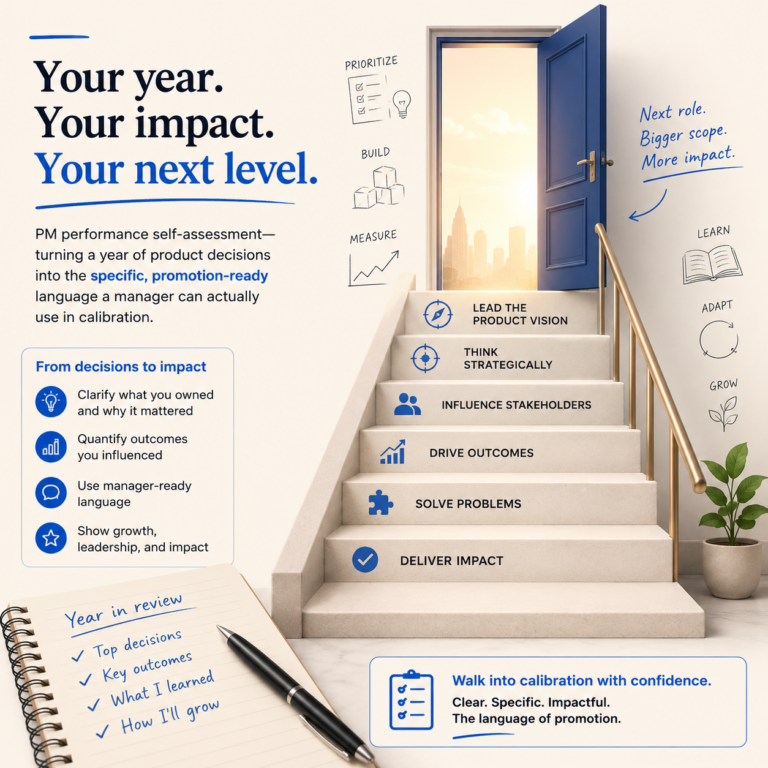
The gap between PM and Senior PM isn’t just time served. It’s a fundamentally different way of working — and understanding that difference is the key to closing it faster. Most PMs wait for the promotion to land in their lap. The ones who get to Senior PM quickly are the ones who start operating at that level before they officially hold the title.
This guide breaks down exactly what a senior product manager does differently, what skills you need to develop, and how to build the track record that makes the promotion a formality rather than a conversation.
What Does a Senior Product Manager Do?
A senior product manager owns significantly more scope and works with significantly more ambiguity than a PM. The fundamental difference isn’t that they manage more features: it’s that they operate more independently.
At the PM level, you’re typically given clear problems to solve. You work within a defined product area, you escalate blockers to your manager, and you receive guidance on prioritization and strategy. You’re strong at execution: writing clear specs, running sprints effectively, collaborating with your engineering and design team.
At the senior PM level, you’re expected to find the problems yourself. You set the strategy for your area, you make prioritization calls without needing sign-off on every decision, and you proactively identify and remove your own blockers. You work across multiple teams, manage complex stakeholder relationships, and have a visible impact on business outcomes, not just feature delivery.
This plays out often on small teams: at a 20-person startup, two PMs with nearly identical titles can end up with very different actual scope. One waits for her manager to hand her the next quarter’s priorities every single planning cycle. The other shows up to planning with three ranked options and a recommendation, already having talked to the two engineers who’d actually build whichever one gets picked. Only one of them tends to get the senior title within a year, and it has nothing to do with who worked harder; they both did. It comes down to who was already operating like a senior PM before anyone called her one.
A senior product manager is also expected to contribute beyond their own product area. That means mentoring junior PMs, contributing to team processes, representing the product perspective in cross-functional conversations, and helping shape the organization’s product strategy.
Senior Product Manager vs Product Manager: Key Differences
| Product Manager | Senior Product Manager | |
|---|---|---|
| Problem definition | Given | Self-directed |
| Strategy | Informed by others | Owns for their area |
| Stakeholder management | Team-level | Cross-functional, executive |
| Ambiguity tolerance | Moderate | High |
| Decision-making | With guidance | Independently |
| Scope | Single product area | Multiple areas or complex domain |
| Mentorship | Receiver | Contributor |
| Visibility | Team | Organization |
Skills You Need to Become a Senior Product Manager
Becoming a senior product manager requires you to grow across three dimensions: strategic thinking, execution at scale, and organizational influence.
Strategic thinking — Senior PMs think about the “why” behind every decision and can articulate how their product area connects to the company’s broader strategy. They’re comfortable reasoning about markets, competitors, and long-term positioning, not just the next sprint. If you want to develop this, start reading beyond your immediate product domain. Understand your company’s business model deeply. Build a view on where your market is going and what that means for your product.
Execution at scale — Senior PMs don’t just run their own team well. They drive outcomes across multiple workstreams, manage competing priorities without getting overwhelmed, and build processes that make their team more effective over time. Strong product manager skills at the execution level are the foundation, but senior PMs apply them at a larger surface area.
Organizational influence — This is the dimension that surprises many PMs. Getting to Senior PM isn’t just about product craft. It’s about your ability to build alignment, navigate organizational dynamics, and get things done through people you don’t manage. That means stakeholder communication, executive presence, and the ability to make a compelling case for your priorities in high-stakes conversations.
Data fluency — Senior PMs are deeply comfortable with data. They don’t need analysts to interpret everything for them. They can form hypotheses, define metrics, pull and interpret basic data, and build a coherent narrative around what the numbers mean for the product.
User research leadership — Senior PMs don’t just commission research: they lead the team’s approach to discovery. They ensure the team has a continuous pipeline of user insight and that product decisions are systematically grounded in real user behavior.
How Long Does It Take to Become a Senior Product Manager?
The honest answer is: it depends more on what you do than how long you’ve been a PM. That said, most Senior PM roles require 3–5 years of product management experience. Companies typically expect a PM to have at least 2–3 years at the PM level before promoting to Senior PM.
But the timeline isn’t the variable you should optimize for. The variable you should optimize for is scope. Every time you can take on a harder problem, a larger product area, or a more complex stakeholder environment, you’re building the experience base that makes you a Senior PM. A PM who spends five years in a tightly scoped, well-defined product area will be less ready for Senior PM than one who spent three years pushing into increasingly ambiguous territory.
If you’re looking at entry-level PM jobs right now, understanding this arc early helps you make better decisions about where to work, what roles to take, and how to accelerate the trajectory.
How to Build the Experience Needed for Senior PM Roles
Seek out ambiguity. When there’s an unclear problem that nobody wants to own, volunteer. Ambiguity is where senior PMs live. Getting comfortable with it now is the fastest way to build the mindset and skills the role requires.
Build cross-functional relationships proactively. Don’t wait for your manager to make introductions. Build your own relationships with engineering leads, data analysts, designers, marketing partners, and business stakeholders. Senior PMs are effective because they influence the organization, and influence comes from relationships, not title.
Drive an outcome, not just a feature. When you have an opportunity to frame your work around a business outcome, “we improved trial-to-paid conversion by 18%” rather than “we shipped the onboarding redesign,” take it. Senior PM performance is evaluated on outcomes, not output. Start speaking that language now.
Develop and document your product thinking. Write down your product frameworks, your views on the market, and your hypotheses about user behavior. This develops your strategic thinking and creates artifacts you can use in interviews and promotion conversations.
Ask for stretch assignments. Tell your manager explicitly that you’re working toward Senior PM and ask what the gap looks like from their perspective. Then ask for the assignments that will close that gap. Most managers will help you if you make the conversation explicit.
Worth pushing back on the common advice to just “ask for more scope” and then wait patiently. A common pattern: one PM sits for two years waiting for a manager to hand her a bigger mandate that never comes, while a peer at the same level simply starts reading the notes from a cross-team dependency meeting nobody else wanted to own, shows up with a point of view on it, and is quietly running that workstream within a quarter. Nobody assigned it to him; he just started doing the work before the title caught up. The most common way this stalls out entirely: PMs mistake being maxed out on their current scope for building the track record that gets them promoted. Flawless execution of a scope that never grows reads as “reliable mid-level PM,” not “ready for senior,” no matter how many hours go into it.
Senior Product Manager Interview: What to Expect
Senior PM interviews are harder than PM interviews in specific ways. The bar for strategic thinking and ambiguity tolerance is higher. You’ll face more questions about cross-functional leadership, organizational influence, and owning outcomes end-to-end.
Common Senior PM interview themes:
- Tell me about a time you identified a product opportunity that nobody else saw
- How have you managed a situation where your team’s priorities conflicted with a major stakeholder’s expectations?
- Walk me through a product decision you made with incomplete data
- How do you think about building a product strategy for a new market?
- Describe a time you influenced a decision you didn’t have direct authority over
For these, structure your answers around outcomes, what changed because of what you did, rather than activities, what you did. If you want to brush up on the full interview prep playbook, our guide on PM interview questions and answers covers the frameworks in detail.
Senior Product Manager Salary in 2026
Senior product manager compensation varies significantly by company size, location, and domain, and it varies enough between sources that no single number tells the full story. Levels.fyi, which skews toward larger tech companies and includes equity, puts the US average Senior PM range at roughly $200K–$365K total compensation. Broader-market data anchored more in base salary, the kind Glassdoor captures across companies of all sizes, lands meaningfully lower, closer to $125K–$190K base. The gap between those two isn’t a contradiction; it’s mostly company stage and equity exposure. Here’s a rough blend across both:
| US (Tech Hub) | US (Non-Hub) | UK | Remote (Global) | |
|---|---|---|---|---|
| Base Salary | $165K–$220K | $125K–$190K | £80K–£120K | $100K–$160K |
| Total Comp (with equity) | $220K–$400K | $150K–$230K | £100K–£150K | Variable |
FAANG-level companies pay well above these ranges. Per Levels.fyi’s company-specific data, Senior PMs at Google and LinkedIn report median total compensation in the $400K–$530K range, with top-end packages at Google reaching into the high $600Ks, driven almost entirely by equity, not base salary. Treat any single FAANG figure as a moving target; these numbers shift with stock price and level-mapping changes more than with the job itself.
For a broader context on PM compensation across levels, see our guide on product manager salary 2026.
How to Transition Into a Senior Product Manager Role
There are two paths: internal promotion and external move.
Internal promotion is often faster if you’re at a company where you’re already building the right track record and your manager is invested in your growth. The key is making your senior-level work visible, not just to your manager but to the broader organization. Present in all-hands meetings. Write internal documents that get shared widely. Volunteer for cross-functional initiatives.
External move is worth considering if your current company doesn’t have senior PM openings, your manager isn’t actively supporting your growth, or the scope available to you is too limited to build the experience you need. When interviewing externally for a Senior PM role before you’ve officially held the title, frame your experience in terms of the scope and impact you’ve already been operating at, not the title you currently hold.
The transition to Senior PM is one of the most significant in a PM career. It’s the shift from being a strong individual contributor to being someone who can genuinely shape the direction of a product and the culture of a team. Start building toward it intentionally, and it comes faster than you think.
The Mindset Shift That Matters Most
Technical skills, data fluency, and stakeholder management will get you to the door of Senior PM. But there’s a mindset shift that determines whether you actually make it through, and it’s worth naming explicitly.
Most PMs at the junior and mid-level think of their job as shipping features. That’s understandable: features are the visible output of PM work, and there’s a real satisfaction in watching something you defined get built and released. But senior PMs think of their job as moving metrics and solving problems. Features are one possible tool for doing that, but they’re not the goal.
When you make this shift, everything changes. You stop asking “how do I build this feature well?” and start asking “is this the right feature to build, and if I build it, will it actually solve the problem I think it will?” That question leads you to more discovery work, more experimentation, more honest assessment of uncertainty. It makes you slower at shipping the wrong things and faster at shipping the right ones.
The shift also changes how you talk about your work. Instead of “I shipped the dashboard redesign,” you say “we improved weekly active usage by 14% by rethinking how users access their key workflows.” The former describes output. The latter describes impact. Senior PM performance reviews, promotions, and external job searches all go better when you lead with the latter.
If you’re evaluating whether you’re operating at the Senior PM level right now, ask yourself this: in the last 90 days, have you driven a measurable improvement in a business outcome that you can point to specifically? If yes, you’re building the right track record. If not, that’s the work to focus on.
References:
- Lenny Rachitsky — “The PM Career Ladder” — lennysnewsletter.com
- Reforge — “Advancing Your PM Career” — reforge.com
- Levels.fyi — Senior Product Manager salary data — levels.fyi