
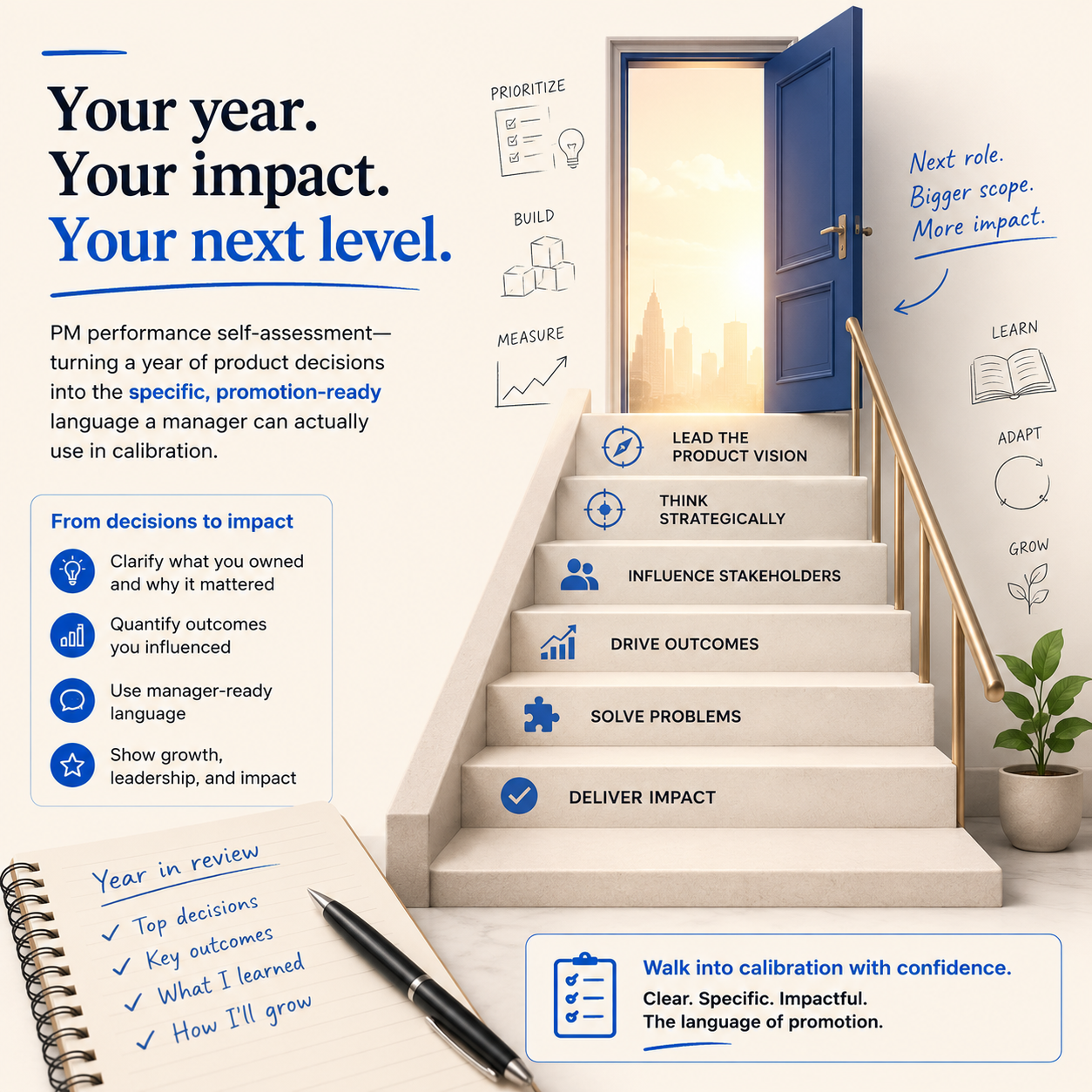
How to Write a PM Performance Self-Assessment That Gets You Promoted
A PM mentored two cycles ago had genuinely the strongest year on her team: she led the pricing overhaul that lifted expansion revenue, she ran point on a messy cross-functional launch nobody else wanted, and she mentored two junior PMs into their first solo ship. Her self-assessment described none of that as impact. It read like a status report — “led pricing project,” “coordinated launch,” “supported junior PMs” — three bullet points that could have described three different, much smaller years. She didn’t get the promotion that cycle. Her manager fought for her anyway, using details pulled from Slack threads and 1:1 notes, because the self-assessment gave him almost nothing to work with.
That’s the failure mode worth naming up front: most PM self-assessments read like a task list because PMs are trained to write status updates, not promotion cases. A self-assessment is not a status update. It’s the document your manager will lean on, sometimes word for word, when they argue for you in a calibration room you’re not in — and if you’re chasing the jump described in how to become a senior product manager, the self-assessment is often the single highest-leverage document you’ll write that cycle.
Why Most PM Self-Assessments Undersell the Work
PMs are unusually bad at this for a specific reason: the job is inherently about making other people’s work visible — the engineer’s clever fix, the designer’s research insight, the data scientist’s model — and PMs internalize that habit of deflection so thoroughly that it shows up in their own self-assessments. Writing “I led the pricing overhaul” feels like taking credit that belongs to the team. So the instinct is to soften it into “I coordinated the pricing overhaul with engineering and finance,” which is more modest and less useful, because it erases the judgment calls that were actually the PM’s job to make.
The same instinct that makes PMs say yes to every stakeholder request instead of pushing back shows up here too: it’s more comfortable to describe your year as a series of things you helped with than to claim the specific calls you made alone. But a self-assessment that reads as universally agreeable and collaborative, with no individually owned decisions in it, gives a calibration committee nothing to differentiate you from every other “collaborative, hardworking” PM in the room. The document needs friction — a real decision, a real tradeoff, a real moment where you were the one who had to choose — or it reads as interchangeable with everyone else’s.
Harvard Business Review’s guidance on self-assessments makes a point that applies directly here: the document should cover the entire review period against actual goals, not just what’s freshest in memory, and it should end with a concrete list of accomplishments rather than a narrative of effort. Effort is not what gets rewarded in a calibration conversation. Outcomes are, and outcomes require you to actually name your own decisions.
What to Actually Include: Impact, Not Activity
Every bullet in a self-assessment should answer three questions: what changed, because of what specific decision, measured how. “Led the pricing overhaul” answers none of them. “Proposed and shipped a usage-based pricing tier for the mid-market segment after discovery showed per-seat pricing was blocking expansion; expansion revenue in that segment grew 18% over two quarters” answers all three, and it’s the same underlying work — just described as a decision with a consequence instead of a task with a label.
This matters more for PMs than for almost any other role, because a PM’s actual job — deciding what not to build, negotiating a scope cut that protected the launch date, killing a feature that wasn’t working — is largely invisible in any system of record. Nobody files a ticket for “decided against building X.” If you don’t narrate that decision yourself, it doesn’t exist for the person reading your self-assessment.
Structure each accomplishment around three things:
- The decision, not the deliverable. Not “shipped the onboarding redesign” — “identified that 40% of signups were dropping at the integration step, cut two lower-value onboarding paths to focus engineering time there, and shipped a redesigned flow.”
- The tradeoff you owned. What did you say no to, and why? This is often the strongest evidence of PM judgment, and it’s the thing most self-assessments omit entirely because saying no doesn’t feel like an accomplishment.
- The number, even an imperfect one. “Reduced onboarding drop-off from 40% to 27%” beats “improved onboarding” every time. If you don’t have a clean number, use a directional one and say so — “roughly cut churn-driving support tickets in half based on category tagging” is still far more credible than an unquantified claim.
Turning PM Work Into Promotion-Ready Language
The gap between a weak self-assessment and a strong one is almost never the underlying work — it’s the framing. The table below shows the same real accomplishments rewritten from task-list language into decision-and-impact language.
Weak vs. Strong Self-Assessment Language
| Weak (Task-List) | Strong (Decision + Impact) |
|---|---|
| “Ran the Q3 roadmap planning process.” | “Killed two lower-priority Q3 initiatives after a stakeholder review surfaced conflicting priorities, freeing capacity for the retention work that became our highest-impact Q3 project.” |
| “Worked with engineering on the API redesign.” | “Pushed back on engineering’s initial API design after it would have broken three partner integrations; the revised version shipped on the same timeline with zero partner-side breakage.” |
| “Improved onboarding experience.” | “Cut onboarding drop-off from 40% to 27% by removing two low-value setup steps identified through funnel analysis and five user interviews.” |
| “Supported the pricing team.” | “Built the usage data model that the pricing team used to set tier thresholds, catching a pricing error that would have undercharged our top 15 accounts by an estimated $340K annually.” |
| “Mentored two junior PMs.” | “Ran weekly 1:1 coaching with two junior PMs; both shipped their first solo features this cycle and one was promoted off my recommendation.” |
Every “strong” version still credits the team implicitly — none of them claims sole authorship of the outcome — but each one is specific about what the PM personally decided, pushed back on, or built. That specificity is what a manager can actually repeat in a calibration meeting without it sounding like a paraphrase.
Jackie Bavaro’s framework for reaching senior PM, shared through Lenny’s Newsletter, makes a similar point about visibility: PMs with high autonomy often get less credit, not more, because their manager doesn’t see the decisions being made in real time. If you’re not narrating your own judgment calls somewhere — in the self-assessment if nowhere else — nobody else is going to do it for you.
Where Self-Assessments Break Down
There are three specific ways even strong PMs sabotage their own self-assessment, and each is worth naming because each is fixable in under an hour.
Recency bias eats the first three quarters. Most self-assessments over-index on whatever shipped in the last six weeks because that’s what’s freshest in memory, while the biggest win from Q1 gets a single line or gets dropped entirely. Pull your actual project list — from your roadmap tool, your calendar, or your 1:1 notes — before you write anything, and force yourself to find at least one substantial accomplishment from every quarter of the review period.
The weakness section becomes either fake-humble or a confession. “I need to work on communication” tells a promotion committee nothing. Neither does listing a real failure with no recovery attached — that just reads as a liability. The fix is to pair every named weakness with what you changed because of it: not “I struggled with stakeholder alignment on the Q2 launch” alone, but that sentence plus “so I started running a pre-read with affected teams 48 hours before any launch decision, which cut last-minute escalations to zero for the rest of the year.”
The self-assessment doesn’t map to the actual leveling criteria. This is the most common and most costly mistake. A PM writes a strong, honest account of their year that has nothing to do with what their specific company’s leveling rubric actually rewards at the next level — scope of ownership, cross-functional influence, strategic ambiguity handled — because they never went and read the rubric. If your company has a documented career ladder, write your self-assessment directly against its language. If it doesn’t, infer the criteria from what got the last two people promoted at your level and write toward that instead. The criteria shift again once you’re past senior IC — the jump from PM to Head of Product is judged almost entirely on organizational and people scope rather than shipped features, so a self-assessment written for that transition should read very differently from one written for a senior-IC promotion, even if the underlying work looks similar on paper.
A Worked Example: From Task List to Promotion Case at a 25-Person Fintech Startup
A PM at a 25-person fintech startup was up for promotion from PM II to Senior PM, and the real constraint she faced was that the company had no written leveling rubric — the founders had never formalized one past “senior PMs own more ambiguity.” She and her manager disagreed initially about how to handle that: her manager wanted her to write a standard accomplishments list and let him make the level argument separately; she pushed back, arguing that if there was no rubric, her self-assessment needed to define what “owning ambiguity” looked like in practice, in her own words, so the case wasn’t left entirely to her manager’s advocacy in a room she wasn’t in.
She rewrote three sections of her self-assessment specifically to demonstrate ambiguity ownership: the compliance-driven feature she scoped from a two-sentence legal requirement into a shipped spec with no PRD template to follow, the pricing model she built when the company had never priced a usage-based product before, and the vendor evaluation she ran and owned end-to-end after the original owner left the company mid-project. Each was framed as a decision made under genuine uncertainty, not a task completed against a clear brief. The promotion went through in that cycle, and — more durably useful — the three examples she wrote became the informal starting point for the leveling rubric the company wrote six months later.
How Often Should You Actually Write This?
Most companies only ask for a self-assessment once or twice a year, which is exactly the cadence that produces recency bias and forgotten wins. Lenny’s Newsletter’s survey of career ladders across 20+ companies makes clear how inconsistent formal leveling criteria are from company to company — which means you can’t outsource the job of tracking your own case for promotion to the process. Keep a running document, updated monthly in five minutes, with one line per notable decision: what you decided, what you traded off, what changed as a result. When review season arrives, you’re editing a document instead of reconstructing a year from memory, and you won’t lose Q1’s biggest win to recency bias.
Using the Self-Assessment Beyond the Review Cycle
The document doesn’t stop earning its keep once the review is submitted. The same decision-and-impact language you sharpened for your self-assessment is exactly what you need if the promotion comes with a comp conversation — negotiating a product manager offer well depends on being able to state your impact in concrete, numbers-backed terms on the spot, not reconstruct it under pressure in the room. PMs who’ve already done the work of translating a year of decisions into specific outcomes walk into that conversation with material, not vague confidence.
It’s also raw material for anything you do to build visibility outside your immediate team. A personal brand as a product manager — a LinkedIn post, a conference talk, an internal wiki writeup — is usually just a self-assessment’s best examples, rewritten for a different audience. The pricing model built under uncertainty, the launch scope you cut to protect a date, the vendor evaluation you inherited mid-project: these are the same stories, reused. If your self-assessment is full of specific, well-framed decisions, you’ve already done most of the hard work for every other place you’ll need to tell that story.
This week, open a blank doc and write down the three decisions from this year you’re proudest of — not the three biggest launches, the three decisions. If you can’t immediately name what you traded off to make each one, that’s the gap your next self-assessment needs to close, before your manager has to go digging through Slack to make the case for you.
References
- Harvard Business Review — “How to Write an Effective Self-Assessment,” Marlo Lyons, 2023 — https://hbr.org/2023/12/how-to-write-an-effective-self-assessment
- Lenny’s Newsletter — “Becoming a Senior Product Manager,” featuring Jackie Bavaro — https://www.lennysnewsletter.com/p/senior-product-manager
- Lenny’s Newsletter — “Product Management Career Ladders” — https://www.lennysnewsletter.com/p/product-management-career-ladders