
What Is Agile Product Management? A Plain-English Guide
A team can run a perfect sprint retro — every ceremony on the calendar, every rule in the Scrum Guide followed — and still not be agile, in exactly the way a car with no engine is still a car: all the right parts, arranged correctly, going nowhere. A retro that spends its full hour debating whether a ticket should be labeled a bug or a task, without a single mention of a user or whether the last sprint moved a metric, is the clearest version of this failure. It’s not a broken process. It’s a process running flawlessly toward the wrong goal.
Agile gets thrown around constantly in product and engineering circles — sometimes as a methodology, sometimes as a philosophy, occasionally as a buzzword that means little more than “no fixed plan.” For a PM trying to understand what agile actually means for the role, as opposed to the calendar, this guide cuts through that noise.
What Agile Actually Is
Agile is a set of values and principles for software development formalized in the Agile Manifesto in 2001. The core idea is simple: instead of planning everything up front and building for months before showing anything to users, work happens in short cycles, feedback comes early, and course gets adjusted continuously.
The Agile Manifesto prioritizes:
- Individuals and interactions over processes and tools
- Working software over comprehensive documentation
- Customer collaboration over contract negotiation
- Responding to change over following a plan
That last one matters most for product managers. Agile assumes nobody gets everything right upfront, and that the ability to learn and adapt quickly beats the ability to plan comprehensively. What it does not say, anywhere in the original document, is “hold a daily standup.” The ceremonies are implementation details. The willingness to be wrong and change course fast is the actual point, and it’s the part teams lose first under deadline pressure.
What Agile Product Management Means in Practice
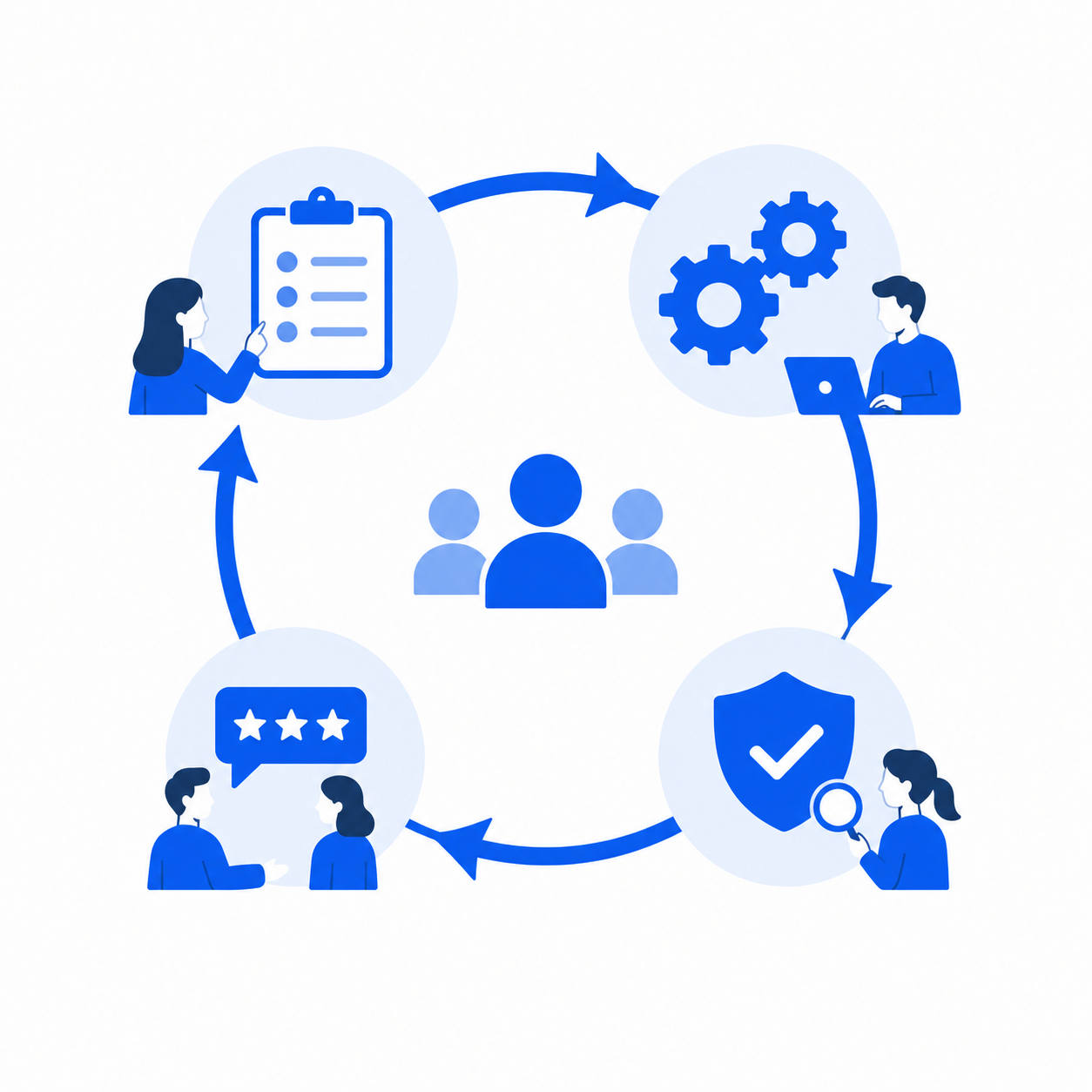
Agile product management means running the product function in a way that embraces iteration, continuous discovery, and short feedback loops. It shapes planning, how the PM works with engineering, and how changing priorities get handled.
In an agile environment, a product manager typically:
- Maintains a prioritized product backlog — an ordered list of work the team could take on next
- Works in sprints — fixed periods, usually one to two weeks, in which the team commits to a specific set of work
- Participates in regular ceremonies: sprint planning, daily standups, sprint reviews, retrospectives
- Writes user stories rather than detailed feature specs
- Reviews and accepts, or rejects, completed work at the end of each sprint
- Continuously refines the backlog based on new information, not on a fixed schedule
The product manager is not a project manager here. They’re not running the sprint. They’re feeding the team well-defined, properly prioritized work and making calls when the team needs direction — and the quality of those calls, not the neatness of the board, is what separates a team that’s actually agile from one that’s just fast.
Agile Frameworks: Scrum, Kanban, and SAFe
Agile is the philosophy. Scrum, Kanban, and SAFe put it into practice, and picking the wrong one for a team’s actual work pattern is a common, avoidable source of friction.
| Framework | Work structure | Best fit |
|---|---|---|
| Scrum | Fixed sprints, usually 1–2 weeks, with defined roles and ceremonies | Feature teams with predictable, plannable work |
| Kanban | Continuous flow through a board, no fixed iteration | Support, maintenance, or teams where work arrives unpredictably |
| SAFe | Scrum principles coordinated across many teams via shared planning cycles | Large enterprises with multiple teams on one platform |
Scrum is the most widely used framework. Per the current Scrum Guide, the Scrum Team is a Product Owner, a Scrum Master, and the Developers, working as one self-managing unit rather than the older “Product Owner directs a separate Development Team” framing. The Product Owner orders the backlog and represents the customer — in many companies, this is the product manager or a role very close to it. The Scrum Master owns the team’s effectiveness and keeps Scrum defined as it’s actually meant to work, not just its rituals. The four key events — Sprint Planning, the Daily Scrum, the Sprint Review, and the Sprint Retrospective — exist to serve inspection and adaptation, not to fill a calendar slot.
Kanban is more fluid: work flows continuously through a board instead of fixed sprints, and the framework focuses on limiting work in progress to reduce context-switching. It’s a better fit than Scrum for support, maintenance, or any team where work arrives unpredictably — forcing a two-week box around interrupt-driven work just adds ceremony without adding value.
SAFe applies agile principles at scale across multiple teams working on the same product or platform, adding structure for planning and dependency management that a single Scrum team doesn’t need. It’s common in large enterprises — for a PM at a company with many engineering teams, understanding SAFe clarifies how work actually flows across the organization instead of just within one team’s board.
Where Agile Turns Into Theater
A retro like the one described above is rarely an isolated bad day — it’s the predictable endpoint of a team that adopted Scrum’s rituals without the discipline behind them, and it’s rarely a dramatic failure. It’s a slow drift.
A 15-person engineering org starts strong: real sprint goals tied to a metric, genuine retros that change something the following sprint, a backlog that gets ruthlessly reprioritized when new user data comes in. Eight months in, the sprint goal becomes “complete the tickets in this sprint” — a description of the process, not a goal. Retros produce the same three action items every two weeks because nobody’s tracking whether last retro’s fixes landed. The backlog gets reordered by whoever complained loudest in Slack, not by evidence. Every ceremony still happens, on time, with full attendance. The team would say, accurately, that they’re “doing agile.” They’ve just stopped doing the thing agile was for.
The fix isn’t a process audit — it’s one blunt question in the next retro: when’s the last time this ceremony changed a decision? No specific answer from the last month means that ceremony has become theater. Cut it, or give it back its job.
The Product Manager vs Product Owner Question
In Scrum, the accountability for the backlog sits with the Product Owner. In many organizations, the product manager and product owner are the same person. In others, they’re separate roles entirely.
When they’re separate, the product manager tends to focus on strategy — market research, vision, roadmap, stakeholder management — while the product owner focuses on execution: writing user stories, managing the sprint backlog, accepting completed work. The product manager vs product owner breakdown goes deeper into where that line typically falls. Understanding where a company draws this line matters — a PM expected to also act as product owner is working across both strategy and execution simultaneously. Common, manageable, but worth naming explicitly instead of discovering it by accident when both jobs pile up in the same week.
How Agile Changes the Product Roadmap
In a traditional waterfall approach, the roadmap is a detailed plan: feature A in Q1, feature B in Q2, full release in Q3. Dates are fixed. Scope is fixed. Changes are expensive because everything downstream was built assuming they wouldn’t happen.
In an agile environment, the product roadmap looks different. Outcome-based roadmaps are more common than feature-based ones — instead of committing to specific features on specific dates, the commitment is to outcomes and problems worth solving, leaving room for the how to emerge through discovery and iteration.
This doesn’t make agile roadmaps vague — it makes them honest, acknowledging the team will learn things during execution that change details, structured to absorb that learning without the whole plan falling apart the first time reality disagrees with the original assumption.
Agile and Backlog Prioritization
One of the most important things a PM does in an agile environment is maintain and prioritize the backlog. This isn’t a one-time exercise — it’s an ongoing discipline that shapes every sprint, and it’s the first thing that degrades when a team drifts into theater mode.
A well-prioritized backlog keeps the team working on the highest-value items; a poorly managed one leads to shipping features nobody asked for while missing the outcomes that matter. The guide to backlog prioritization frameworks covers five methods — RICE, MoSCoW, and ICE among them — that hold up well in agile environments.
Common Challenges in Agile Product Management
Stakeholder pressure on scope. Agile is supposed to protect teams from constant scope changes, but stakeholders often want to add things to an active sprint anyway — a PM needs to explain the real cost of mid-sprint changes and route new requests to the backlog instead of caving to whoever asked most recently. Roadmap visibility is a related tension: outcome-based roadmaps can feel vague to stakeholders who want to know exactly what’s shipping and when, and part of the job is translating the process into language they can trust, not just tolerate. Moving fast on the wrong things is the speed trap — agile enables speed, but speed on the wrong problem is just efficient failure, and discovery work can’t be skipped just because the team is moving in two-week sprints. And mistaking process for agile is the root of all three: daily standups and calling things sprints doesn’t make an organization agile, and teams that run every ceremony without the underlying willingness to change course are doing exactly what the opening retro was doing.
Getting Started in an Agile Environment
For anyone new to product management or joining an agile team for the first time, the fundamentals worth focusing on: learn how the team’s specific process actually works — Scrum, Kanban, or a hybrid, not just the label on the door; understand who owns the backlog and how it gets refined in practice, not just on paper; build the habit of continuously talking to users and bringing those insights into sprint planning; write clear, testable user stories that give engineers enough context without prescribing the solution; and get comfortable making fast decisions, since agile processes surface questions constantly and waiting for perfect information isn’t an option.
For anyone preparing to break into product management and wanting to understand how agile fits into the role before day one, the guide on how to break into PM with no experience covers the full picture.
Check This Before Your Next Retro
Agile product management isn’t a specific set of rules. It’s a way of working that values learning over planning, iteration over perfection, and customer feedback over internal assumptions. The ceremonies are supposed to serve that — not the other way around.
So here’s the test worth running before the next retro: pick the last three retrospective action items and check whether any actually changed something in the following sprint. If the honest answer is no, the team isn’t doing agile anymore — it’s performing it, on schedule, with a straight face. The fix isn’t a new framework. It’s deciding, out loud, that a ceremony only stays on the calendar if it’s still doing its job.
References
- Manifesto for Agile Software Development
- The Scrum Guide
- Atlassian: Agile Product Management
- Marty Cagan, Inspired: How to Create Tech Products Customers Love