
How to Write a Competitive Analysis (Free Template Included)
Every product exists in a competitive landscape, whether or not anyone on the team has actually looked at it. Teams routinely spend two full quarters building a feature that three competitors had already shipped a year earlier — not because anyone was lazy, but because nobody had checked. A competitive analysis for product managers is not a one-time exercise done before launch. It’s an ongoing practice that should inform your roadmap, your positioning, and your prioritization decisions throughout the product lifecycle.
This guide covers how to write a competitive analysis from scratch, including a free template you can use immediately, and the mistakes that turn a competitive analysis into a document nobody opens again after the kickoff meeting.
What Is a Competitive Analysis, and Why Do Product Managers Need It?
A competitive analysis is a structured assessment of the products, positioning, strengths, weaknesses, and strategies of your competitors. For product managers, competitive analysis serves three primary purposes: informing product strategy, sharpening positioning, and identifying differentiation opportunities.
Competitive analysis for product managers differs from the marketing-focused competitor research you might find in a business school textbook. Marketing competitive analysis focuses primarily on messaging, pricing, and channels. PM competitive analysis goes deeper into the product itself: the features offered, the UX decisions made, the customer segments targeted, the jobs being served, and the bets being placed on future direction.
Without a competitive analysis, product managers risk two mistakes, and the second one is far more common than teams tend to admit. The first is building something competitors already do better — spending six months on a feature that is table stakes in your category. The second, quieter mistake is ignoring a genuine differentiation opportunity because nobody ever laid the competitors side by side long enough to notice they all share the same blind spot.
Marty Cagan and Bob Baxley make a related point in their writing on competition at the Silicon Valley Product Group: chasing competitors feature-for-feature is usually a distraction from the customer problems that actually decide who wins. A more practical middle ground: competitive analysis isn’t about copying or ignoring competitors, it’s about knowing exactly what you’re choosing not to build and why. A well-executed competitive analysis for product managers also sharpens your product vision statement. When you understand where competitors are going, you can make a more deliberate bet on where you are going differently. For more on that, see our guide on writing a product vision statement.
How to Write a Competitive Analysis Step by Step
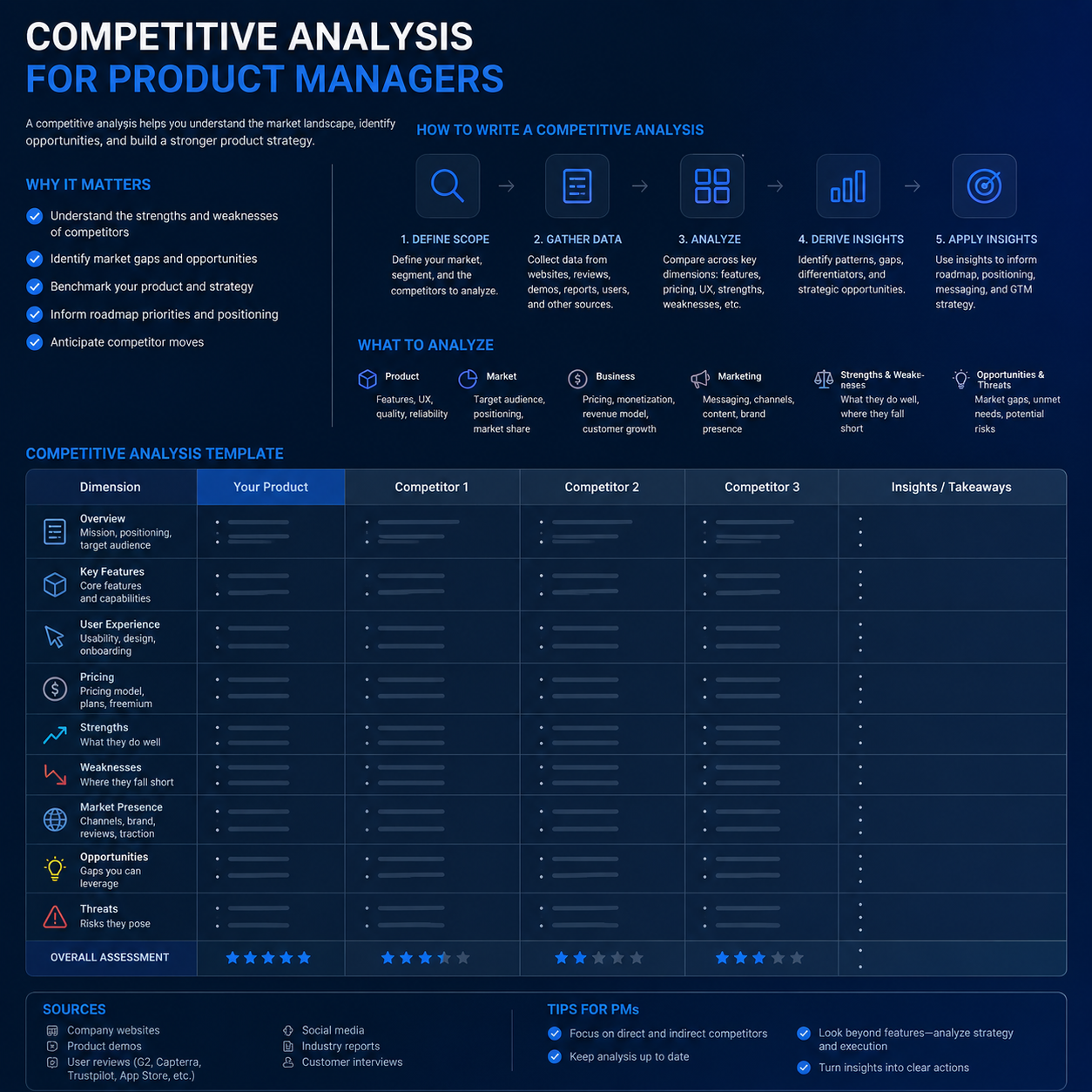
Competitive analysis for product managers follows a clear process. Here is how to run it, and how the process typically plays out from scratch.
Step 1: Define the scope. Decide who you are analyzing and why. Direct competitors serve the same customer with a similar solution. Indirect competitors serve the same customer with a different solution. Substitutes solve the same problem in a completely different way (including doing nothing). A thorough competitive analysis for product managers covers all three categories, but you may choose to go deep on direct competitors and lighter on indirect ones.
Step 2: Identify your competitors. Sources include: Google search for your focus keyword, the G2 or Capterra category pages for your product type, your own sales team’s notes on who they lose deals to, customer interviews where users mention what they used before or considered, and App Store / Product Hunt category pages.
Step 3: Research each competitor. For each competitor on your list, gather information across six dimensions: product features, pricing model, target customer, positioning and messaging, distribution and channels, and recent product direction (new launches, blog posts, job listings, investor announcements).
Step 4: Score and compare. Use a structured matrix to compare competitors across dimensions that matter to your customers. Do not score everything; score the dimensions your customers actually care about and that differentiate products in your category.
Step 5: Identify gaps and opportunities. Look for patterns in what competitors are not doing. Are they all serving enterprise customers and ignoring SMBs? Are they all focused on one workflow and leaving adjacent jobs unserved? These gaps are potential differentiation opportunities. Running your findings through a jobs-to-be-done framework at this stage is one of the more reliable ways to spot a gap that a feature-by-feature matrix will miss entirely.
Step 6: Draw strategic conclusions. The output of a competitive analysis is not the matrix — it is the strategic implications. For each major finding, write one sentence that starts with “This means we should…” or “This means we should not…” These become inputs to your product strategy.
Here’s what that can look like in practice. Picture a 14-person B2B SaaS startup selling scheduling software to dental clinics, running this process against four competitors, one of which has ten times its headcount. The matrix shows the startup behind on integrations across the board — an unsurprising, low-value finding. The useful insight comes from Step 5: every competitor’s onboarding flow assumes the buyer is a practice owner, but the startup’s own support tickets show office managers are the ones actually setting up the software, and they keep getting stuck on steps written for someone with financial authority they don’t have. None of the competitors have touched that gap. Rebuilding onboarding around the office manager persona instead of the owner becomes the single biggest driver of activation for the next two quarters — not a new integration, not a pricing change, just noticing what six well-funded competitors all missed in the same place.
Where Competitive Analysis Breaks Down
Most competitive analyses fail quietly. Nobody declares the exercise a waste of time. It just stops getting updated, and eventually stops getting referenced at all. Here’s where that tends to happen, and what actually fixes it.
It becomes a data dump instead of a decision tool. A 40-tab spreadsheet with every competitor’s every feature checked off is not a competitive analysis — it’s a filing exercise. If you can’t point to a single roadmap decision the document changed, the format is wrong, not the effort.
It gets built once and treated as permanent. It’s common to inherit a “competitive analysis” that is eighteen months old and still being cited in planning meetings as current. Pricing had changed twice, one competitor had pivoted entirely, and nobody had noticed because the document itself had no owner and no review date.
It turns into feature-chasing instead of strategy. The most common failure mode is a team that reads “competitor X shipped Y” as an automatic instruction to ship Y too. Sometimes that’s right. Often it isn’t: the feature might serve a segment you’ve deliberately chosen not to serve, or exist because that competitor has a technical debt problem you don’t have. Treat every competitive finding as an input to a strategic conversation, not a roadmap item on its own.
It skips the “so what.” Conventional advice says more data makes a better analysis. In practice, a three-competitor analysis with sharp strategic implications beats a twelve-competitor spreadsheet with none. If Step 6 above is thin or missing, the rest of the document isn’t doing its job, no matter how thorough the research looks.
Free Competitive Analysis Template for Product Managers
Use this template to structure your competitive analysis. Copy it into Notion, Google Sheets, or any doc tool your team uses.
Competitive Analysis — [Your Product Name] Date: | Owner: | Next Review:
Analysis Scope: Direct competitors / Indirect competitors / Substitutes
Competitors Analyzed: [List]
Competitor Profiles
For each competitor, fill in:
- Company name:
- Product name:
- Target customer:
- Core value proposition (one sentence):
- Pricing model and range:
- Top 5 features:
- Biggest strengths:
- Biggest weaknesses:
- Recent product moves (last 6 months):
Comparison Matrix
| Dimension | Our Product | Competitor A | Competitor B | Competitor C |
|---|---|---|---|---|
| [Key feature 1] | ||||
| [Key feature 2] | ||||
| [Pricing] | ||||
| [Target segment] | ||||
| [UX quality] | ||||
| [Integrations] |
Gaps and Opportunities
- Opportunity 1: [description]
- Opportunity 2: [description]
- Opportunity 3: [description]
Strategic Implications
- Finding 1: This means we should [action]
- Finding 2: This means we should not [action]
- Finding 3: This means we should watch [competitor/trend]
What to Include in Your Competitive Analysis
The most common mistake in competitive analysis for product managers is capturing too much information without enough interpretation. A 40-tab spreadsheet of competitor features is not a competitive analysis — it is a data dump.
Here is what actually belongs in a competitive analysis and what to leave out.
Include: positioning and messaging (what they say and who they say it to), pricing model and tiers, target customer segment, core workflow and primary use case, differentiating features (not every feature — the ones that define the product), recent strategic moves, and the underlying bets about the future that their roadmap implies.
Leave out: exhaustive feature checklists, UI screenshots of every page, historical background on the company’s founding, and speculation about internal culture or team size unless it has a specific strategic implication.
Add: direct quotes from reviews on G2, Capterra, or the App Store. User reviews tell you exactly what customers like and hate about competitor products in their own words. This is often the single most valuable section of a competitive analysis, because it reveals the emotional reality of using the competing product — the small daily frustration that never makes it into a feature comparison — rather than just its feature list. Mapping a few of those complaints onto a customer journey map for your own product is a fast way to see whether you’re at risk of the same complaint.
How to Turn Competitive Analysis Into Product Decisions
A competitive analysis that sits in a shared drive and never influences a roadmap decision is a waste of time. Here is how to make sure yours actually shapes what you build.
Feed it directly into your prioritization framework. When you are scoring features with a method like RICE or ICE, competitive context is a valid input. A feature that addresses a well-documented weakness of your top competitor has higher strategic value than the raw usage score might suggest — treat a strong competitive signal as a nudge on the “confidence” input, not an excuse to skip scoring altogether.
Use it to pressure-test your positioning. After completing the competitive analysis, read your current marketing copy and ask: could this description apply to any of my competitors? If yes, your positioning is not differentiated enough. Use the gaps you found in the analysis to sharpen what makes your product distinct.
Make it a living document. Markets move fast. A competitive analysis completed six months ago may already be outdated. Build a quarterly review into your team’s calendar — a two-hour session to update competitor profiles with new launches, pricing changes, and strategic announcements. The Harvard Business Review has made a version of this argument for years: competitive intelligence loses almost all its value the moment it stops being refreshed against what’s actually happening in the market, as opposed to what was true when someone first wrote it down.
Share it with your whole team. Sales, marketing, and support all deal with competitive questions daily. A shared competitive analysis document that is kept current gives every team a consistent, accurate answer to “how are we different from [competitor]?” For connecting your competitive analysis to broader planning, see our guides on writing a product strategy and the difference between a product roadmap and a project plan.
None of this works if the analysis stays a side project. Put an owner’s name and a review date on it before you file it away — if nobody is accountable for updating it, it will be stale within a quarter, and a stale competitive analysis is worse than no analysis at all, because it gives people false confidence in decisions built on outdated facts.
References
- Dunford, A. (2019). Obviously Awesome: How to Nail Product Positioning. Ambient Press.
- Moore, G. (1991). Crossing the Chasm. HarperBusiness.
- Gilad, B. (2015). “Competitive Intelligence” Shouldn’t Just Be About Your Competitors. Harvard Business Review. hbr.org
- Cagan, M. & Baxley, B. Competition. Silicon Valley Product Group. svpg.com