
What Is a Product Manager? Role, Responsibilities & Career Path
What is a product manager? In one sentence: a product manager is the person responsible for defining what a product should do, why it should do it, and making sure the right team builds it the right way. They sit at the intersection of business, technology, and user experience, and they are accountable for the product’s success without directly managing the people who build it.
If that sounds like a strange kind of authority, it is. Product management is one of the most influential roles in any technology company, and also one of the most misunderstood: people outside the field often assume a PM either builds the product hands-on or approves every design and every line of code, and neither is true. This guide breaks down exactly what a product manager does, what skills the role requires, and what a PM career path actually looks like.
What Does a Product Manager Actually Do?
The short answer: a product manager decides what gets built and why. The longer answer is more complicated, because the day-to-day work of a PM varies widely depending on company stage, team structure, and product type.
In practice, the PM role involves three responsibilities:
1. Setting the direction. PMs own the product vision and strategy. They define where the product is going, why it matters, and how it connects to the business. This means writing a product strategy document, maintaining a product roadmap, and aligning stakeholders around priorities.
2. Understanding the customer. PMs are the voice of the user inside the product team. They conduct user research, analyze behavioral data, talk to customers directly, and synthesize what they learn into clear product decisions. Without this, teams build features nobody needs.
3. Driving execution. PMs work with engineering, design, and data teams to take a product from idea to shipped. This means writing PRDs, refining user stories, prioritizing the backlog, running sprint ceremonies, and removing blockers.
Marty Cagan, founding partner of the Silicon Valley Product Group, describes the PM’s job as discovering a product that is valuable, usable, and feasible. That three-part test, valuable for users, usable in practice, buildable by the team, is one of the clearest lenses for understanding what product management is actually about. Teams that skip the “feasible” leg entirely and fall in love with a roadmap engineering never signed off on almost always pay for it later, usually costing more time than the discovery work would have.
Product Manager vs. Other Roles
One of the most common questions people ask is how a PM differs from adjacent roles. The short version:
PM vs. Project Manager: A product manager differs from a project manager in a fundamental way. Project managers focus on how work gets delivered: timelines, resources, risk management. Product managers focus on what gets built and why. PMs own the outcome; project managers own the process.
PM vs. Engineering Manager: Engineering managers lead the engineering team: hiring, performance, technical direction. PMs and EMs are partners. The PM sets the “what”; the EM leads the “how.”
PM vs. UX Designer: Designers own the user experience and interface. PMs and designers collaborate closely: designers make the product usable, PMs make sure the product solves the right problem.
PM vs. Marketing Manager: Marketing managers take a product to market. PMs define the product itself. In practice, both roles work together closely on positioning, launch, and user feedback loops.
Types of Product Managers
Not all PM roles are the same. The type of product you work on shapes the job significantly.
B2C Product Manager — works on consumer products (apps, platforms, marketplaces). Focus is heavily on engagement, retention, and growth metrics. Examples: Spotify, Instagram, Airbnb.
B2B / Enterprise Product Manager — works on products sold to businesses. Focus shifts toward revenue, customer success, and enterprise feature requirements. More stakeholder management, longer sales cycles.
Platform Product Manager — builds internal platforms or APIs used by other engineering teams. The “customers” are internal developers. Requires strong technical understanding.
Growth Product Manager — focused specifically on acquisition, activation, and retention funnels. Heavily data-driven, often running A/B tests continuously.
AI / ML Product Manager — increasingly common. Works on products powered by machine learning. Requires understanding of model capabilities, training data, and evaluation metrics.
These five types can look similar on a job title and barely resemble each other day to day: a strong B2C growth PM largely lives in experiment dashboards, while a strong platform PM largely lives in API design reviews. The title stays the same; the job underneath it doesn’t.
Core Responsibilities of a Product Manager
While the mix varies by company, most PM roles include the following responsibilities:
Discovery and Research
- Conducting user interviews and usability tests
- Analyzing product data and user behavior
- Running competitive analysis
- Identifying unmet customer needs
Strategy and Planning
- Defining and communicating the product vision
- Writing and maintaining the product roadmap
- Prioritizing features using frameworks like RICE or MoSCoW
- Setting OKRs and success metrics
Execution
- Writing product requirements documents (PRDs)
- Writing user stories with acceptance criteria
- Running sprint planning, reviews, and retrospectives
- Managing stakeholder communication and expectations
Launch and Iteration
- Coordinating product launches with marketing, sales, and support
- Defining go-to-market strategy
- Monitoring post-launch metrics
- Iterating based on user feedback and data
A Day in the Life: What This Looks Like in Practice
The responsibilities above read cleanly on paper. In practice, they’re interleaved and constantly interrupted. Here’s a realistic stretch for a mid-level PM at a 60-person B2B SaaS company:
9:00 — Standup with the engineering team, where a blocker on the payments integration comes up. 9:30 — A Slack thread from sales asking why a specific enterprise feature isn’t prioritized this quarter, which needs a considered answer, not a quick one. 10:30 — Two hours blocked for writing a PRD for next sprint’s feature, interrupted twice by design questions. 1:00 — A user interview, one of five scheduled that week to validate a redesign hypothesis. 2:30 — Reviewing last week’s A/B test results, which came back inconclusive, meaning the test needs to run another week. 4:00 — Prepping a one-pager for Friday’s roadmap review with leadership.
None of that is glamorous. What makes it product management rather than project coordination is the judgment calls layered on top: deciding the sales question deserves a real answer instead of a placation, deciding the inconclusive test is worth another week rather than shipping on a hunch, deciding which of five competing priorities gets the one-pager’s spotlight on Friday. That’s the job.
What Skills Does a Product Manager Need?
Strong PMs combine three skill sets that don’t usually show up in the same person: strategic thinking, technical fluency, and human empathy.
Strategic skills: Understanding market dynamics, competitive positioning, business models, and how product decisions connect to company goals. This is what separates product managers from feature managers.
Analytical skills: Comfort with data: defining metrics, reading dashboards, interpreting A/B test results, and making decisions when the data is incomplete. You don’t need to be a data scientist, but you need to speak the language.
Communication skills: PMs spend more time communicating than doing almost anything else. Writing clear specs, running effective meetings, giving feedback to designers, aligning executives: all of it comes down to how well you communicate.
Technical fluency: You don’t need to code, but you need to understand how software is built well enough to have credible conversations with engineers. PMs who can’t speak to technical tradeoffs lose credibility fast.
User empathy: The best PMs are obsessed with their users. They understand not just what users do, but why they do it and what frustrates them.
For a full breakdown, see our guide to product manager skills.
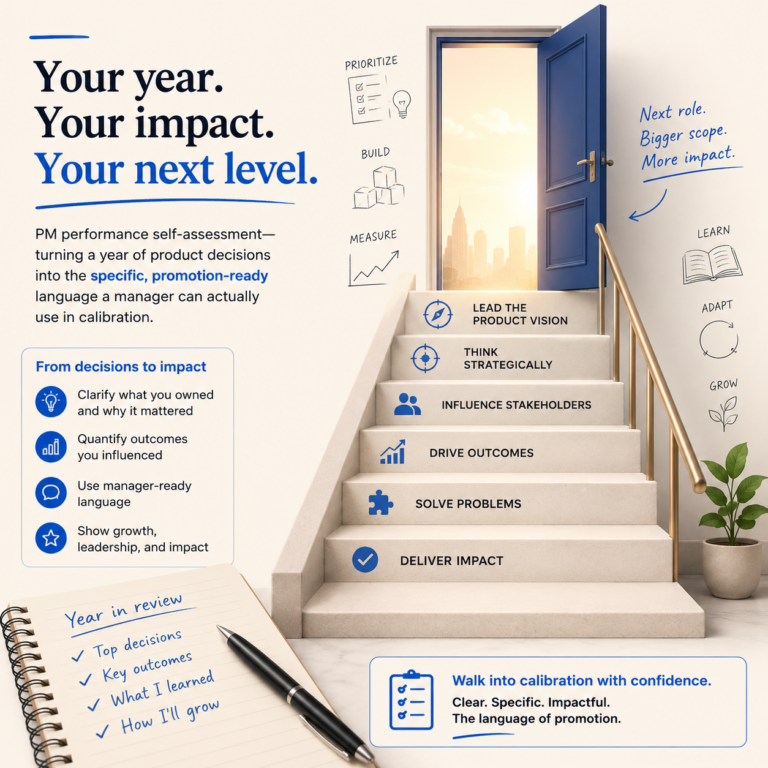
Product Manager Career Path
The PM career ladder typically looks like this, though titles vary by company:
Associate Product Manager (APM)
Entry-level role, common at larger tech companies (Google, Meta, Microsoft). Structured program, close mentorship. Often, the path for new graduates breaking into product.
Product Manager (PM)
The standard mid-level role. Owns one or more product areas. Expected to work autonomously with engineering and design. Requires 1–4 years of experience.
Senior Product Manager
Leads larger product areas or a major product line. Influences team-level strategy, mentors junior PMs. Usually 4–8 years of experience.
Principal / Staff Product Manager
Individual contributor track for PMs who go deep on strategy and execution without moving into management. Equivalent to a Director but without direct reports.
Group Product Manager (GPM) / Director of Product
First management role. Leads a team of PMs. Responsible for a broader product portfolio. Balances coaching and execution.
VP of Product
Senior leader responsible for the entire product organization. Defines product vision, allocates resources, and presents to the board and executive team.
Chief Product Officer (CPO)
C-suite role. Sets product strategy at the company level, works alongside CEO, CTO, and CMO.
This ladder looks more linear on paper than it plays out in practice. The jump from Senior PM to Group PM or Director is usually the one that actually changes the job: everything below it is still primarily about a person’s own judgment on a product, and everything above it is about other people’s judgment, and whether the manager can develop it in them.
How to Break Into Product Management
Most PMs don’t come from a single background. Successful product managers have started as engineers, designers, consultants, marketers, customer success managers, and researchers.
The most reliable path is to build a portfolio of product thinking (case studies, side projects, or product critiques) and to get as close to product work as possible in your current role. See our full guide on how to break into product management with no experience for a step-by-step approach.
Once you’re in the job search, the PM interview process is unique — it tests product sense, analytical thinking, and behavioral competencies simultaneously, and a resume built around task lists rather than outcomes will struggle to get you there in the first place. Our product manager resume guide covers how to fix that before you apply.
Where the “What Is a PM” Job Description Breaks Down
Most explanations of the PM role, including the sections above, describe the job at its best. Here’s where the tidy description stops matching reality, and what actually happens instead.
“PMs decide what gets built” breaks down under a dominant stakeholder. In theory the PM owns prioritization. In practice, at plenty of companies a founder or a single large customer effectively sets the roadmap, and the PM’s real job becomes managing the gap between that reality and what the team believes it’s empowered to decide. Recovery: be explicit with your team about which decisions are genuinely yours and which aren’t — false autonomy is worse for morale than acknowledged constraints.
“PMs are the voice of the customer” breaks down when research gets skipped under deadline pressure. It’s easy to say user research matters; it’s the first thing cut when a launch date is fixed and time runs short. Features shipped on assumption instead of evidence tend to underperform, and the underperformance almost always traces back to that shortcut. Recovery: protect a minimum viable amount of research time the same way you’d protect an engineering buffer, as a non-negotiable line item, not a nice-to-have.
“PMs drive execution” breaks down when the PM becomes the bottleneck. A PM who insists on reviewing every ticket and approving every small decision isn’t driving execution; they’re slowing it down while looking busy. Recovery: the healthiest teams tend to have a PM who’s comfortable being wrong about small decisions in exchange for engineers and designers moving fast on their own judgment.
What Makes a Great Product Manager?
Technical skills and frameworks will only take a PM so far. The best PMs share a few traits that are harder to teach:
Intellectual curiosity. Great PMs are constantly asking why. Why do users drop off here? Why does this competitor win in the enterprise? Why did this feature succeed when the last one failed?
Comfort with ambiguity. Product management involves making decisions with incomplete information, conflicting signals, and competing stakeholders. PMs who need certainty before they act struggle.
Strong judgment. Every week, a PM makes dozens of decisions: what to build, what to cut, what to escalate, what to ignore. Good judgment is the compounding asset of a great PM career.
Ability to influence without authority. PMs have no direct control over engineering, design, or data. Everything is achieved through alignment, trust, and persuasion.
Product Manager Salaries in 2026
PM compensation varies significantly by company size, location, and level. The ranges below reflect blended base-salary data — actual total compensation at large tech companies runs considerably higher once equity and bonus are included:
| Level | US Base Salary Range |
|---|---|
| Associate PM | $95,000 – $130,000 |
| Product Manager | $130,000 – $180,000 |
| Senior PM | $170,000 – $240,000 |
| Director of Product | $220,000 – $300,000+ |
| VP of Product | $280,000 – $400,000+ |
These base ranges are consistent with what Glassdoor and Levels.fyi report across the market. Total compensation tells a different story: Levels.fyi puts total comp at large tech companies at roughly 1.5–2x these base figures once RSUs and bonus are factored in, and considerably more at the senior IC and director levels. See our full breakdown of product manager salaries in 2026 for data by company and geography.
So, What Is a Product Manager — In Practice?
A product manager is responsible for defining the right product, understanding the user it serves, and driving the team to build and ship it, but the job is really made of dozens of small daily judgment calls, not the clean three-part definition at the top of this page.
If you’re evaluating whether this role is right for you, don’t just check whether you like the responsibilities listed above. Sit in on a sprint planning meeting if you can, or shadow a PM for a day, and pay attention to whether the ambiguity energizes you or drains you. That reaction is a better predictor than any skills checklist.
References
- Cagan, Marty. Inspired: How to Create Tech Products Customers Love. Wiley, 2018.
- Silicon Valley Product Group. svpg.com
- Levels.fyi. “Product Manager Compensation Data.” levels.fyi
- Glassdoor. “Product Manager Salaries.” glassdoor.com